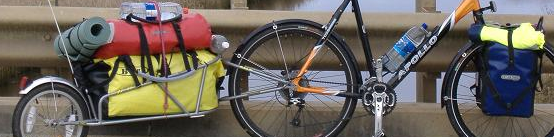

The famous BOB Trailer. I towed this one from Launceston Tasmania to Perth Western Australia. That’s about 4,000 km’s, though actual pedalling was more like 3,000 km’s.
It was man-handled onto the Bass Strait ferry to get from Devonport to Melbourne and onto the Indian Pacific train to cross the Nullabour. The remaining distance I pedalled.
And while in WA I also spent a couple of weeks pulling it along the Munda Biddi Trail.

So what’s it like to actually ride with a BOB ? You’re towing a trailer with weight on it. Sometimes you’re pulling it and sometimes it’s pushing you. And you have a bigger turning circle. Like a truck.
Steering and handling. It feels solid on the ground and prefers smooth easy cornering, nothing jerky. Front panniers and a handlebar bag balance the weight really well and improves handling.
Pedalling on the flat. Take off is a bit slow but once you get going the rolling weight behind you actually adds momentum. It’s really quite cool.
Pedalling Uphill. It’s a drag , really , and depending on the day it can be hard work. Get used to it. Choose a low gear and be patient.
Braking. You can feel the weight pushing you from behind while applying the brakes. Mostly it’s fine, but there are moments when it isn’t. Using the front brake in a corner while going fast down hill is one of them, don’t do that.
Slowing down requires heavy use of the rear brake and only a light touch on the front. I really like hydraulic disc brakes.
NOTE : I had the idea that fitting a large 203mm disc on rear would improve slowing with a trailer, but an email to Surly told me frame manufacturers prefer we use the standard 160mm disc because of extra stress on the frame. Too bad, it seemed like a good idea.
Parking. Man-handling a bike/trailer outfit to lean on something feels like pushing and pulling a loaded wheelbarrow. And it’s easy to miss a good photo opportunity because of the time and effort required.
A side-stand will not support it. A centre-stand might or might not, depending on the day. I don’t like my bike falling over so I just put up with leaning it on things.
And a hand-brake is a really good idea too. A rubber strap on the rear brake lever will do it.
Warning : If the bike & trailer fall over do not pick up the bike and expect the trailer to stand up with it. You will bend something. The bike and trailer need to be lifted together.

BEFORE AND DURING THE TRIP . . . .
Buying the BOB. I read some posts and reviews, ummed and ahhed for a while, then found a second hand one on Ebay. It had a few scratches but was otherwise solid. Even came with a skewer.
First, overhaul the moving parts. Wheel bearings, swing arm bolt, and skewer rollers. They needed to be dismantled, cleaned, examined for wear, then greased and reassembled.
The trailer was in good used condition. I added a long hi-vis flag.
For a trip I needed spares. A 16″ inner tube & tyre, skewer, securing pins, and perhaps a spare pivot bolt. Didn’t get the bolt.
The bag needed protection from future holes. Long travel means vibration and rubbing against the metal frame on the outside and against the cooker, cans, camping gear, etc on the inside.
I cut up an old foam sleeping mat. One piece went on the trailer floor and one inside on the bag floor. The off-cuts became side padding inside the bag.
Packing the bag. This took trial and error. Heavier items low and to the front, like water cask, cans, Trangia, etc. Light-weight food and gear to the rear. Lighter bulky items like sleeping bag, sleeping mat, tent, etc went on top.
Loading and unloading the trailer. My early assumption was to pack/unpack the bag on trailer and always have convenient access to gear. Doesn’t really work out that way.
The simplest method is to pack and securely close the bag, then stuff it into the trailer, and don’t pull it out again until you make camp that night.
The plastic clips that open/close the bag are in a difficult position hidden behind the trailer frame, which means pulling the bag out and opening it on the ground.
I also strapped my personal over-night bag on top of the BOB bag, as well as some water bottles, mat, and food bag.
Roadside access to gear was quite an exercise in unpacking and repacking.
Hook up the trailer. You will do this everyday, both empty and loaded. Take care around the rear derailleur cable and don’t smack your head on the back of the bike. Hand brake on !
An empty trailer is one-hand easy : Hook swing-arm onto skewer, insert pins, stuff bag into frame.
A loaded trailer is heavy and needs muscle : Position the bike and trailer close to each other, stand over the trailer, grab hold on each side of the swing-arm, do a straight lift so you don’t twist your back, hook swing-arm onto skewer, and insert pins.CONCLUSION
I’ve read a few Panniers vs Trailer articles online, and now I’ve actually traveled with both myself.
The physical difference between the two is simply replacing the rear rack and panniers with a trailer and bag. The front end doesn’t change, it still has two panniers and a handlebar bag.
The bike’s behaviour definitely changes though, and our riding technique needs to change with it.
Would I use it again ? Absolutely, I loved it, I could carry extra gear in a comfortable well-packed way, and the bike/trailer rig actually feels like I’m traveling on a journey.
But it does depend on where I’m going, what I’m carrying, and how long I’m going for.
Riding across Australia with it was great , even though some hills are hard work and the boat and train required extra handling.
Pulling it along the Munda Biddi Trail was not so great. It’s a semi-rough dirt trail, which was do-able and fun, but I think bike bags would’ve been a better choice.
————————————————–
Leave a Reply